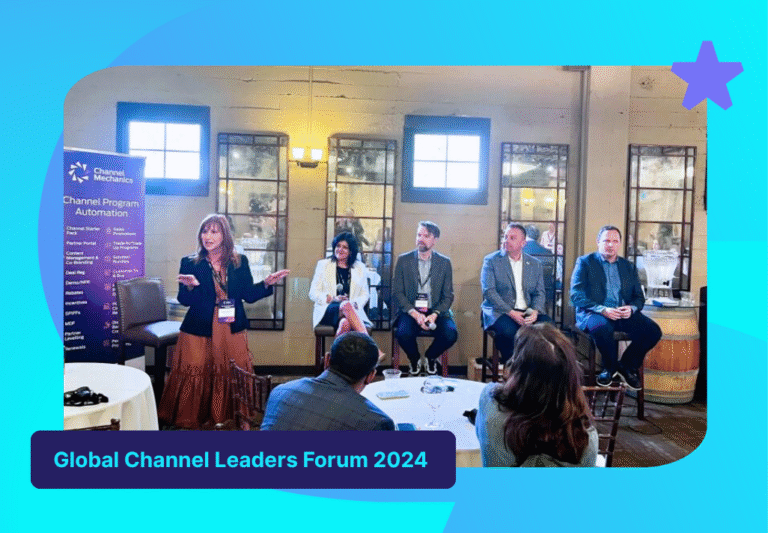
Global Channel Leaders Forum – London 2025
In February 2025, Channelscaler hosted the UK edition of the Global Channel Leaders Forum in London. Although this event is held annually in California, this year marked a significant milestone as we brought it to the UK for the first time.
As a result, the event brought together over 50 channel leaders and consultants. Together with a panel of industry experts, attendees shared strategies and approaches in building and enabling resilient, impactful, and profitable partnerships.
To kick things off, Kenneth Fox, CEO of Channelscaler, opened the event with a sneak peek of our new unified PRM platform, combining best-of-breed features from Channelscaler. He also highlighted key updates from the 2025 roadmap, including platform enhancements, new AI-driven use cases, and the planned rollout of ecosystem-focused products.
The Partnership Paradigm Shift
Next, Margaret Adam, Director of Product Marketing at Channelscaler, delivered a thought-provoking keynote on The Partnership Paradigm Shift, exploring how the channel must evolve to meet new ecosystem realities.
Firstly, she painted a candid picture of the current state of the channel, highlighting persistent challenges: siloed operations, disconnected teams, and under-resourced programs. Many vendors still rely on spreadsheets to navigate fragmented data and multiple systems. This creates frustration on both sides with limited visibility into channel impact and ROI.
This complexity has been exacerbated by industry-wide changes. Over the past decade, cloud and digital transformation have fundamentally reshaped the partner ecosystem. This has demanded significant changes in how partner programs are structured and delivered.
Margaret warned that we are halfway through a significant transition toward a more ecosystem-centric approach to partnering. At the core of this change are The Four Cs of Ecosystem Impact:
- Co-Sell – Improving seller collaboration and mastering partner attribution.
- Cloud Marketplace – Increasing partner participation and improving profitability for partners active on marketplaces.
- Competency & Specialization – Evolving partner programs to encourage greater specialization and competency development within the partner base.
- Customer Success – Incentivizing across the lifecycle, and creating better alignment between vendor and partner customer success functions.
For each of these areas, Margaret highlighted emerging technologies, and innovative strategies that are shaping the future of partnerships.

Looking Ahead: Data-Driven, Automated and Resilient
Looking ahead, Margaret discussed how the next evolution of partner ecosystems involves:
- Transitioning from manual processes to automated, scalable solutions.
- Using AI-powered analytics to optimize performance and attribution.
- Creating customizable partner programs that adapt to unique partner needs and evolve with the ecosystem
“The end state is a partner ecosystem that is transparent, dynamic, and adaptable—where partners can navigate and engage in ways that maximize their success.”
The Partnership Paradigm Shift outlines the transformation from siloed operations, lack of investment, and opaque performance to a future defined by real-time insights, AI-driven decision-making, and empowered partners.

Margaret’s Final Thoughts
“Given the pace of change, channel leaders must embrace data, automation, and AI to enhance collaboration and drive measurable success. The race is on, those innovating with AI and automation are gaining momentum, while others risk falling behind.”
The session closed with a call to action. To adopt best practices in partner program architecture and leverage automation to scale efficiently.
Panel Discussion: Building and Enabling Resilient, Impactful and Profitable Partnerships
The afternoon closed with an executive panel, moderated Sean O’Connell, Chief Product Officer at Channelscaler.
The panel featured seasoned channel leaders from organizations at various stages of the channel program lifecycle, from recruiting and expanding their partner base and program to those rationalizing their ecosystem and optimizing their programs.

Panel Discussion:
The panel opened with a discussion on Partner Differentiation & Partner Journey Automation:
Firstly, describing Extreme Networks approach, Natalia Vianden explained:
“Our partner segmentation strategy considers revenue, geography, market saturation, enablement, and technical capabilities. We keep entry barriers low to ensure accessibility while structuring our four-tier system to reflect increasing investment, commitment, and expertise.”
“I think there are three different ways to create partner journeys, maturity, competencies, and go-to-market strategy. New partners have a different path from those progressing to higher tiers, and we ensure top performers are rewarded. Similarly, we guide partners through technical enablement. Some focus purely on sales, while others invest in training, offer post-sales services, or co-build solutions for greater margins. Additionally, we’re expanding into new models like MSPs and cloud marketplaces. This opens fresh opportunities for partners to engage with us in non-traditional ways.”
Simon Beard then discussed the number one ask from partners, Ease of Doing Business.
“We made a decision to work with Channelscaler, as the platform enabled us to automate more of what we did with our partners. Beyond that, the other key challenges that we had to overcome were integrating data sets and lots of different systems. The other big challenge, was how do we give access to the marketing information, the tools, the technical documentation, and everything else all in one place?
For me, one of the key metrics of automation success is, are you getting your partners coming back, revisiting the platform? Partners have to be able to very rapidly get the information about what to do, how to sell your product and how to use the tools, so that they can focus their energies on the right revenue opportunities.”

Laurent Le Provost then shared his insight and experiences of the Digital Transformation of the SAP Partner Program.
“We began our digital transformation three years ago. We developed “SAP for Me” a tool that provides partners with a clear view of their program status: tier level, obligations, key dates, and certifications. It also offers insights into their installed base, customer pipeline, project implementation, and renewal management, critical in the cloud world.
Another key area is the automation of our rebate program, reducing manual work and providing real-time visibility. Instead of partners chasing answers on deal eligibility and earnings, a front-end interface now delivers clear insights. This aligns everyone with real-time data for more efficient business reviews.
Reducing complexity and improving data access is essential for partner success. We also prioritized system integrations, ensuring partners access everything: rebates, development funds, and loyalty tools through a unified experience without navigating multiple platforms.”
The next topic for the panel was Partner Incentives which Dave Silke shared his experiences about the value of recognition.
“When you talk about partner incentives, everyone immediately thinks of a financial reward, but they can, and should, go beyond that. While discounts, MDF, and rebates matter, true motivation also comes from engagement, enablement, and a sense of success. Partners need a compelling reason to sell—whether it’s unique offerings, revenue potential, or strong support. Don’t forget that partners love to be recognized, awards and plaques go a long way to making them feel appreciated!
Over time, the right incentives evolve from financial benefits to deeper advocacy, turning a transactional relationship into a true partnership.”
Final Thoughts from the Panelists
- Laurent: Talk To Your Partners
“I think the key takeaway from our experience was the importance of listening to your partners. They’ll tell you exactly what you’re doing right, what you’re doing wrong, and what is the pain they’re going through. To do that, I recommend you conduct regular surveys to gather direct feedback from your partners.”
- Natalia: Automate From the Start
“We automate everything. In fact, I don’t launch anything if I can’t automate it. My first question, when someone wants a program, is what is the data source and how quickly can I really make it visible? It really must be a value-add for the partner.”
- Simon: Be Easy to Do Business With
“You need to have a relationship with a partner, where they know it’s going to be easy to do what they want to do, and they’ve also got to be able to see what’s the reward of working with you versus another vendor. What is it that’s going to make the deal for them? Those are the two key things I would see give you a competitive advantage.”
- Dave: We’re in a People Business
“It’s not all a process. At the end of the day, a partner is a person. If you can spend the time and develop the relationship and engage, you’ve got something that fixes a pain. And then you’re going to be successful. But don’t forget the people, the people are who sell for you.”
Finally, Kenneth Fox brought the afternoon to a close, sharing his own final thoughts on the days discussions.
“Everything I have heard this afternoon reinforces the need for ease of doing business, and the importance of tracking actionable data, not just data for the sake of data, data that you can do something with. And as the old saying goes, you can only manage what you measure, and it really is true.”
If you’d like to learn more about how our unified PRM platform can help you build and scale resilient, impactful, and profitable partnerships, reach out to our team today.