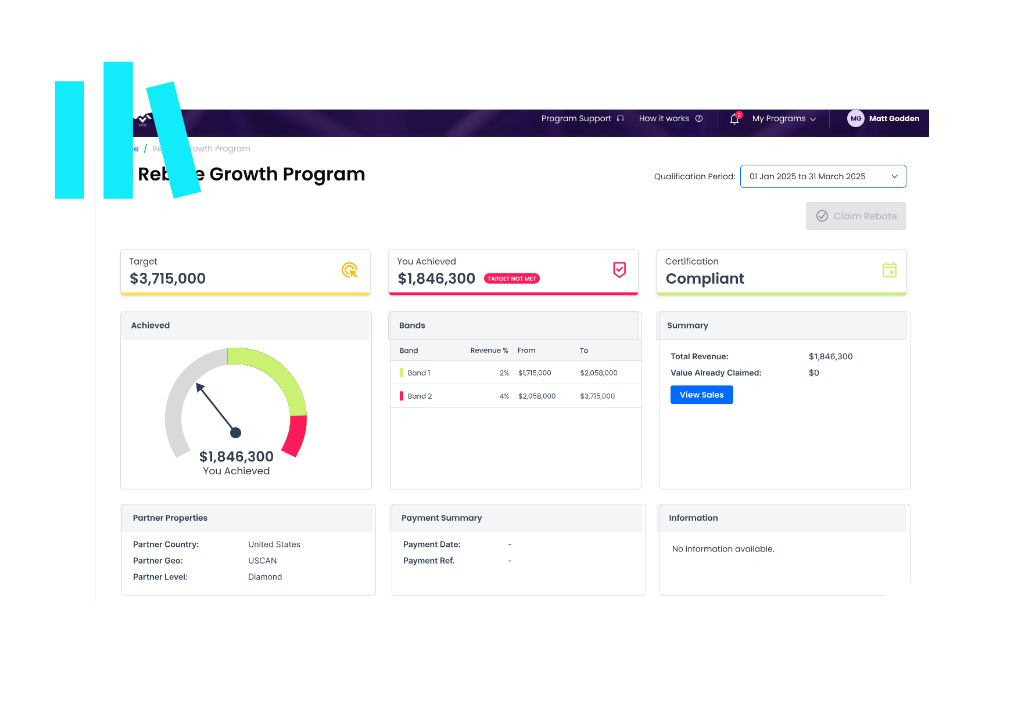

Today’s channel ecosystem looks very different than it did a few years ago. Partners are no longer just traditional resellers, they include ISVs, MSPs, referral partners, marketplaces, and alliances. This evolving landscape requires a more flexible and sophisticated approach to incentives. Modern incentive strategies must reflect how different partner types go to market and what truly motivates them.
One-size-fits-all models no longer work. Some partners respond to traditional rebates, others are driven by individual SPIFFs, while others seek enablement and joint marketing support. As Kenneth Fox, CEO of Channelscaler, noted in a previous webinar, “If you want to grow wallet share, look at rebates. If you’re trying to gain mindshare, maybe combine a rebate with a SPIF where it’s allowable.”
Additionally, vendors are increasingly adopting tools like dashboards and real-time tracking to bring an “Amazon-like experience” to partners. Partners want speed, transparency, and simplicity and vendors that can offer that will stand out in a crowded space.
Aligning Internal Stakeholders for Success
Even the best-designed incentive program can falter without internal alignment. Securing buy-in from key internal teams especially sales, marketing, finance, and partner account managers (PAMs) is essential to operationalizing incentives effectively.
Partner Account Managers play a critical role in driving incentive adoption and execution. However, they’re often overwhelmed with day-to-day responsibilities. Simply sending a slide deck and expecting results won’t cut it. As Juniper’s Don Lopes pointed out, “You can no longer send an email with a PowerPoint that says, ‘here’s your incentives for the year.’ We need to get more innovative.”
That innovation can come through short videos, simple toolkits, and dashboards that give PAMs visibility into where their partners stand within incentive programs. Timing also matters for example, alerts about goal progress should happen before quarter close, so there’s time to act.
Poly’s Laura Evans emphasized the importance of viewing internal teams as an audience in their own right: “Our internal sellers are just as much a customer. We need to make sure they have the tools to grow and amplify our sales.”
Finance also plays a crucial role. Sunny Song of SentinelOne emphasized the importance of working closely with finance to track ROI: “If you’re not tracking results well, it could jeopardize future funding.”
Measuring ROI from Incentive Programs
Despite advances in automation and analytics, many vendors still struggle to measure the ROI of their incentive programs. This data is critical for proving program success and securing ongoing support from finance and leadership.
Here are seven proven strategies to improve ROI from incentive programs:
- Go with the Flow: Align incentives with behaviors partners are already good at. Don’t expect your program to change their business model.
- Match Rewards to Partner Costs: Understand that selling a new product to a new customer may cost a partner up to 12x more than a simple renewal. Your incentive must reflect that effort.
- Assess Partner Capacity: Consider your current share of the partner’s business and their overall sales productivity. Overstretching expectations leads to poor results.
- Create Tiered, Personalized Targets: Avoid “winner-takes-all” structures. Let each partner compete against their own past performance.
- Understand Product Role: Incentivize based on where your product sits in the partner’s value stack: primary, secondary, or tertiary.
- Factor in Partner Priority: Align your expectations with how important you are in the partner’s portfolio.
- Communicate Early and Often: Internal teams and external partners must be well-informed. Use centralized platforms and real-time visibility.
A dashboard-driven system not only helps track ROI but also builds trust with partners. As Kenneth Fox noted, “If a partner says, ‘where’s this invoice or record?’ you’ve got to be looking at the same data. It has to be the same source of truth.”
Building Incentive Programs That Scale with Growth
Incentive programs are no longer just about offering rewards. They are strategic levers that align partners with your go-to-market objectives, foster loyalty, and drive scalable growth.
To succeed, modern incentive programs must:
- Reflect the complexity and diversity of today’s partner ecosystem
- Offer transparency, speed, and ease-of-use for internal and external stakeholders
- Be data-driven, measurable, and ROI-focused
- Continuously adapt to shifting partner needs and market dynamics
Ultimately, the vendors who will thrive in this evolving channel are those who view incentives not as a tactic, but as a key component of their broader partner and growth strategy.
Gather further insight by reading our blog on: How Data and AI are Shaping the Future of Partner Incentives.
To learn how to build or scale your incentive program with automation, measurement, and flexibility, schedule a demo with Channelscaler today.