The email arrives at 4:47 PM on a Friday. Your top-performing partner in the Northeast region is furious.
They’ve been telling their biggest prospect about a product feature that apparently doesn’t exist. Your partner portal showed it as “available” for three months. Your product team deprecated it six months ago.
The $2.3 million deal dies instantly. The partner starts evaluating your competitors.
This isn’t a story about poor communication or bad timing. This is a story about what happens when companies treat their most valuable business relationships like administrative afterthoughts.
The Information Accuracy Death Spiral
That Friday afternoon disaster reveals a deeper truth about how information inaccuracy kills partnerships systematically.
The product feature mishap wasn’t an isolated incident. It was the predictable result of information living in disconnected systems across your organization.
Product management updates their roadmap in one system. Marketing updates partner-facing materials in another. The partner portal gets updated whenever someone remembers to do it.
Partners make business decisions based on the information you provide them.
When that information is wrong, their decisions become wrong. When their decisions fail because of bad data, they don’t blame your systems—they blame the partnership.
The spiral accelerates from there.
Partners start double-checking everything, which slows down their sales cycles. They lose confidence in your materials and start creating their own, which dilutes your messaging. They begin qualifying opportunities more cautiously, which reduces pipeline velocity.
Eventually, they start evaluating alternatives.
The most successful partners—the ones you can least afford to lose—have the most options. They’re also the least tolerant of operational friction that makes them look unprofessional to their customers.
Information accuracy isn’t a nice-to-have in partner management. It’s the foundation that everything else depends on.
Why Getting More Organized Always Fails
Most executives facing these challenges think tactically rather than systematically. Hire another person to manage the spreadsheets. Create better processes and documentation.
Get more organized.
This approach fails for fundamental reasons that have nothing to do with effort or intention. The problems are structural, not procedural.
Spreadsheets aren’t scalable or integrated by design. Data becomes inaccurate automatically as multiple versions exist simultaneously, creating version control nightmares that misrepresent reality across the organization.
The lack of centralization creates a lack of accuracy, which impacts credibility both internally and externally.
Return to our Northeast partner scenario. The product information lived in three different places: the product roadmap, the marketing materials, and the partner portal. Each system operated independently, creating information lag that made partners look incompetent to their customers.
This isn’t about better processes or more careful updates. This is about structural limitations that create systematic failure.
With more than 70% of total addressable IT spending routed through channel partners, information accuracy becomes a critical competitive advantage.
Revenue walks out the door when partners can’t trust the information you provide them.
The Credibility Crisis
When data accuracy fails, credibility fails. When credibility fails, partnerships fail.
The statistics support what we observe in practice. Partnerships often fail due to insufficient attention to collaborative behavior and internal stakeholder management.
These aren’t abstract relationship problems masquerading as operational issues.
They’re operational problems masquerading as relationship problems.
Partners make business decisions based on the information you provide them. When that information is wrong, their decisions become wrong. When their decisions fail because of bad data, they blame the partnership rather than the data source.
The real business impact is that partners take customers elsewhere.
Partners operate in competitive markets with multiple vendor options available. They choose the path of least resistance when building their business.
If working with you requires navigating operational chaos, they’ll work with someone else. The customer follows the partner, not the vendor.
Your operational choices directly determine partner loyalty and customer retention.
The Strategic Signaling Effect
Companies that view PRM as a technology expense miss the strategic signaling effect entirely. The investment communicates partnership priorities more clearly than any contract language.
We often use a simple analogy to shift executive perspective.
You wouldn’t build your own ERP system from scratch. You wouldn’t build your own CRM system using spreadsheets and email.
Why would you try to build your own PRM system when channel revenue makes up a large part of your business?
Investing in a PRM platform shows partners how serious you are about working with them. It demonstrates commitment to ensuring they have the best possible partner experience when engaging with your organization.
This signaling creates measurable business outcomes that extend beyond operational efficiency.
Partners respond positively to purpose-built systems designed for their specific needs. Engagement rates increase significantly when partners interact with professional platforms versus makeshift solutions cobbled together from generic tools.
By investing in PRM, you place ease of doing business at the heart of your channel go-to-market strategy.
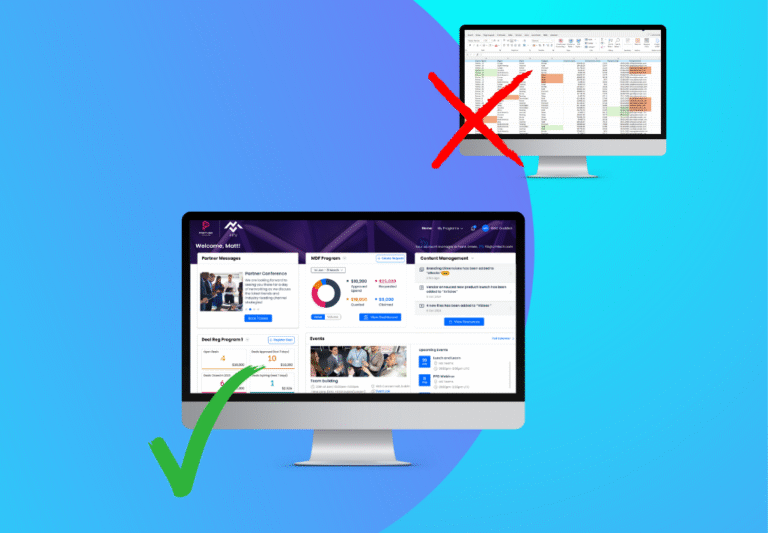
Partners notice this immediately and adjust their behavior accordingly. The difference between logging into a professional partner portal versus downloading spreadsheets from email communicates volumes about your partnership priorities.
The Engagement-Pipeline-Revenue Connection
The business case for PRM investment follows a predictable progression that we’ve observed across customer implementations in multiple industries.
First, partner engagement increases measurably. Professional systems make it easier for partners to access resources, submit deals, and track their progress across programs. Friction decreases, participation increases.
Once partners engage consistently, there’s a direct correlation to increased partner pipeline.
Engaged partners submit more opportunities through deal registration systems. They participate in more marketing programs and campaigns. They invest more time in your solutions and certifications.
Increased pipeline drives increased partner revenue through the ecosystem. The math is straightforward, but the transformation is profound for organizations that make this transition.
This progression explains why the channel software market is on a steep growth trajectory, almost doubling from US$7.46 billion in 2024 to a projected US$13.48 billion by 2028, according to Canalys.
Companies are recognizing that partner ecosystem management isn’t a cost center.
Partner ecosystem management is a revenue multiplier.
The Fundamental Divide
Our experience reveals a fundamental divide in how companies approach partnership investments that determines long-term channel success.
Companies that invest in PRM platforms fundamentally understand and believe in the value of partners. They see partner success as directly connected to their own success and make investment decisions accordingly.
Companies that resist PRM investment either don’t fully buy into the channel model or don’t understand the value of partnerships to their business growth.
This philosophical difference has a direct impact on channel business growth.
The divide isn’t really about budget constraints or technology preferences. The divide is about strategic philosophy and organizational priorities.
Companies in the first category treat partners as extensions of their sales organization. They invest in partner success because partner success drives their success directly.
Companies in the second category treat partners as external entities to be managed rather than enabled. They minimize investment and wonder why partnerships consistently underperform expectations.
The Modern Partnership Reality
Partner ecosystems have expanded beyond traditional boundaries, encompassing diverse partner categories, global territories, and varied business frameworks. As manual operations become inadequate, successful ecosystem management demands sophisticated approaches. Organizations must master five key components: strategic partner acquisition, comprehensive enablement programs, metrics-driven performance tracking, strategic incentive structures, and proactive conflict resolution protocols.
These disciplines work together through integrated systems rather than isolated tools. Partner portals connect seamlessly to deal registration systems. Content management integrates with training platforms and certification tracking. Deal registration eliminates channel conflict.
The platform approach transforms intuition-based channel leadership into data-driven decision making.
You no longer have to guess which partners perform best in different markets, the data tells you. Rather than wondering which programs drive the best results, you measure and optimize continuously. And when it comes to partner engagement, you track metrics directly and refine accordingly.
Beyond Software to Strategy
The companies that succeed in today’s partner economy understand a fundamental truth about PRM implementation.
PRM isn’t software you buy and deploy.
PRM is strategy you implement across your entire channel organization.
The technology enables the strategy, but the strategic philosophy drives the outcomes. Companies that approach PRM as a strategic investment see dramatically different results than companies that approach it as a technology purchase.
Strategic PRM implementation starts with partner experience design rather than feature requirements. How do you want partners to feel when they work with your organization? What should be easy and automated? What should be personalized based on partner type and performance?
The answers to these questions shape platform configuration and deployment.
More importantly, they shape partnership outcomes and long-term ecosystem health.
Partners can tell the difference between companies that see them as strategic assets versus companies that see them as distribution channels. The technology choices you make communicate your partnership philosophy more clearly than any partner agreement or contract language.
The Path Forward
The path from operational chaos to strategic advantage is clearer than most companies realize when they examine their current state honestly.
Start by acknowledging what isn’t working in your current approach. Spreadsheet-based partner management creates more problems than it solves over time. Retrofitted CRMs and basic portals can’t handle partnership complexity at scale.
Recognize the true cost of makeshift solutions across your organization.
Lost revenue opportunities, damaged partner relationships, and operational inefficiency compound over time. The cost of maintaining the status quo exceeds the cost of proper investment.
Understand that partners vote with their feet in competitive markets.
They choose vendors that make it easy to do business and deliver consistent experiences. Your operational choices directly impact their business choices and customer relationships.
Finally, embrace the strategic signaling opportunity that comes with purpose-built PRM platforms. Professional systems communicate partnership commitment in ways that spreadsheets and email workflows never can.
The companies thriving in today’s partner economy made this transition years ago when the market was less competitive. The companies struggling with partnership performance are still managing partners like it’s 2005.
The question isn’t whether to invest in modern partner management systems.
The question is whether you believe partnerships matter to your business success.
Your Northeast partner already gave you their answer. They saw outdated product information in your portal and made their business decision accordingly.
The $2.3 million deal that died on Friday afternoon? That’s not the real cost.
The real cost is that your best-performing partner is now evaluating your competitors.
The market rewards companies that treat partner relationships like the strategic assets they are—and punishes companies that treat them like administrative afterthoughts.
Which category does your organization fall into today?