Every year, partners reset priorities. Budgets shift. Focus narrows. Decisions get made about where to invest time and energy.
Yet many partner programs head into the new year with the same leveling structures, the same assumptions, and the same friction.
This framework isn’t about redesigning partner tiers for the sake of it. It’s about creating clarity, focus, and direction at the exact moment partners are deciding what matters.
Below is a 7 step Partner Reset Framework designed to help vendors rethink partner leveling for 2026, without overengineering, overcommunicating, or overpromising.
Step 1: Reset the Value Definition
Before changing partner tiers, points, or requirements, start with a harder question: What partner behaviors actually drove real customer impact last year?
Not what was easy to measure. Not what looked good on a dashboard. But what genuinely moved the needle.
Then ask a second, equally important question: What behaviors do we want more of this year?
The outcome of this step shouldn’t be a long KPI list. It should be a short, explicit set of priority behaviors that define value going forward.
If you don’t reset this first, everything else just reinforces the past.
Step 2: Resegment Partner Types
One of the fastest ways to break a partner program is forcing every partner into the same leveling path.
Different partner models create value in different ways. Treating them as interchangeable creates friction for everyone.
At a minimum, most ecosystems include:
- Transactional partners
- Services-led partners
- MSPs / MSSPs
- Marketplace or influence led partners
Each of these contributes differently. Each should have a path to level up that reflects their reality.
The outcome here is simple: Multiple paths to progression, aligned to how partners actually operate – not how the program wishes they would.
Step 3: Balance Partner Performance and Potential
If you only score what partners delivered, you miss future growth. If you only score potential, you reward promises over results. You need both.
Assess:
- What the partner has already delivered
- What they could deliver with the right incentives and guidance
This balance changes how you invest.
High potential partners get guided, not ignored. High performers get protected from complacency.
Leveling stops being reactive and starts becoming directional.
Step 4: Simplify the Leveling Logic
Here’s a stress test every program should pass:
Can a partner explain how to level up in 60 seconds or less?
If the answer is no, the program is too complex.
Simplification usually means:
- Reducing requirements
- Grouping metrics logically
- Making progress visible
The goal isn’t to make leveling easier. It’s to make action clearer. The outcome is less confusion and more momentum.
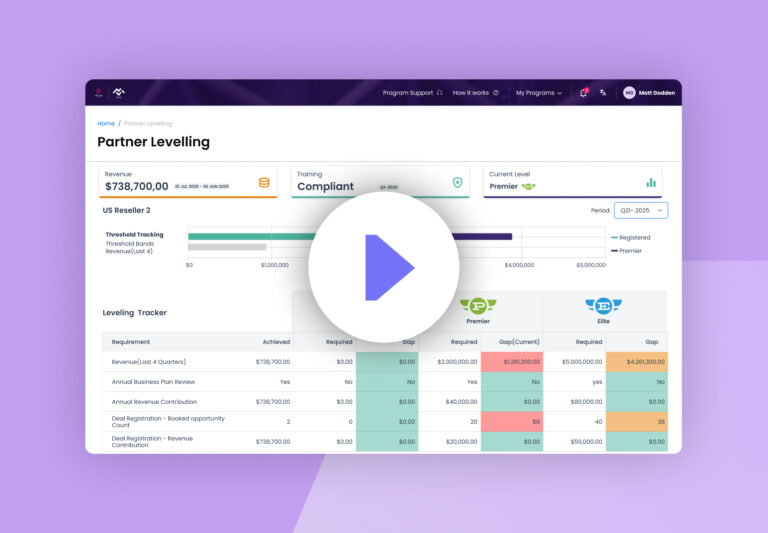
Step 5: Automate Partner Visibility
Partners shouldn’t have to ask where they stand. They should always be able to see:
- Their current level
- Progress toward the next level
- The actions that matter most
- “What if” scenarios that show how effort translates into outcome
When visibility is automated, behaviour changes. Partners become more self-driven. Support queries drop. Engagement rises.
Clarity scales better than enablement ever will.
Step 6: Communicate the Program Reset Clearly
If you’re resetting your program, say so. Do not silently change the rules.
Clear communication should cover:
- Why the reset is happening
- What changed
- What stayed the same
- What partners should focus on now
Transparency preserves trust. Silence erodes it. When partners understand the why, change gets accepted instead of resisted.
Step 7: Lock It in for the Year
Once the reset goes live, consistency matters more than perfection. That means:
- No moving goalposts
- No surprise requirements
- No exceptions that quietly create chaos
Stability builds credibility. Internally, teams align. Externally, partners commit. Outcomes become predictable instead of reactive.
The Core Truth About Modern Partner Leveling
Partner leveling isn’t about static tiers. Resets must create direction.
For vendors: Direction of investment and growth.
For partners: Direction of effort and focus.
When both are aligned at the start of the year, ecosystems scale faster, cleaner, and with far less friction.
Everyone knows where they stand. Everyone knows what matters. And everyone knows how to move forward.
If you’re beginning to explore how a modern leveling framework could support your strategy, our team at Channelscaler is always happy to share examples and insights from across the ecosystem. For more info, schedule a demo with Channelscaler today!
Read our eBook on Partner Leveling to discover how to build partner tiers that reflect the true dynamics of today’s ecosystem!
Gather further insights on our blog: Rethinking Partner Leveling: Why Modern Programs Demand More Than Traditional Tiers