TL;DR
Partner ecosystems have evolved. Most tiering models haven’t.
Partners now influence deals, deliver services, and drive customer success, not just revenue. Yet many programs still measure a narrow slice of partner value, even as 87% of vendors now have or are introducing partner leveling.
Outdated tiering models measure what partners sell, not the value they create across the customer lifecycle.
Bottom line: If you only measure sales, you’re missing partner value.
Background to this eBook
Partner programs have been around for decades, but how we design them, and what partners expect, has changed dramatically.
Channelscaler hosted a webinar in Q4 of 2025 featuring an expert panel who shared their insights and explored how modern tiering and leveling programs can redefine how partner value is measured and rewarded.
The panel featured senior executives responsible for Partner Programs and Strategy:
- Kelly Woodfin, Commercial Director at Ricoh
- Claire Green, Senior International Marketing Manager at Absolute Security
- Diane Krakora, CEO at PartnerPath
- Kenneth Fox, CTO & Founder at Channelscaler
In this eBook, we’ve gathered expert insights from the panel, the live poll responses from webinar attendees, and key takeaways to help you design and manage scalable, transparent modern partner levels/tiers that drive trust and revenue growth, making you, the vendor, easier to do business with
Meet the Panel

The Importance of Leveling Programs

Partner leveling and tiering have grown in importance over the past few years as ecosystems mature and vendors look for more precise ways to reward the partners who deliver the greatest impact.
With more partners participating across more diverse motions, including resell, co-sell, services, marketplace, and non-transactional influence, tiering provides the structure to recognize capability, contribution, and commitment in a consistent, data-driven way.
As competition for partner mindshare increases and partners expect transparency and fairness, smart, evidence-based tiering has become a cornerstone of high-performing channel programs with an increase of 112% over the past 4 years of the number of vendors who have, or are looking to introduce a leveling / tiering system.
“All partners are important, but not all partners are equal.”
Kenneth Fox
CTO & Founder at Channelscaler
“You have to have that ability to differentiate… that is the foundation of why people do tiering or leveling programs. Showing partners in a very easy way where they are and what are the benefits, actually creates competitive advantage for you in the channel, and ultimately helps you win partner mindshare.”

Kenneth Fox
CTO & Founder
Channelscaler
“We must never be so arrogant as to assume that we will be the only vendor in a busy portfolio, in a noisy ecosystem. We need to stand out from the crowd and do something a bit different to empower our partners to feel enabled and then want to do business with us. I think that the purpose of a leveling program is that it gives you the capability to prioritize based on whatever the key metrics are that are important to your business.”

Claire Green
Sr. Int. Marketing Manager
Absolute Security
Why Leveling Counts More than Ever
Today’s partners juggle dozens of vendor programs, customer expectations are increasing, and while traditional tiering requirements that focus on revenue or certifications still matter, they don’t account for the complexity of modern partner ecosystems.
Leveling programs now have to consider partner types that weren’t around ten years ago, and traditional categories that have changed beyond recognition:
- Resellers / VARs
- Services-only partners
- MSPs
- MSSPs
- ISVs
- Cloud/Marketplace led integrators
- Influencers / advisory partners
This shift reflects a broader reality:
Partners don’t just resell anymore. They influence, architect, implement, integrate, support, and renew. Your leveling system must reflect and reward that.
“Take a resale partner selling an on-premise solution, requirements like revenue, compliance, and deal registration are key to the leveling program. But take that same reseller selling a cloud solution, and you still keep the importance of revenue, loyalty, compliance, and deal opportunities. Now though, customer adoption, activation rates, and renewals also come into play. So you really have to consider the fundamentals as well as those additional requirements.”
Kelly Woodfin
Commercial Director, Ricoh Europe
We asked webinar participants how many requirements they included in their leveling or tiering program, the results reflected the changing channel environment.

“If I look back 3 or 4 years ago, less than 3 was definitely the majority; it used to be over 70 or 80% of responses. It’s great to see people evolving their programs to include more requirements.
And that does reflect how the partner ecosystem has changed, because it’s different things for different people, or for different partner types. So, even to see a quarter of the responses have more than four requirements, that does reflect the complexity, and how you cater for that. All of that is very difficult to do without automation and a platform.”
Kenneth Fox
CTO & Founder
Channelscaler
Rethinking Partner Value
Partner sales are an essential measurement for any channel management effort, but sales are only one way partners contribute to a company’s success. Often, partners are critical influencers shaping a customer’s decision to buy. Their endorsement, or better yet, building solutions around your platform, solidifies your position with the customer.
Modern requirements include metrics like:
- Customer adoption
- Activation rates
- Renewal rate or churn influence
- Net new logos
- POC activity
- Customer satisfaction
- Co-selling behavior
- Service delivery quality
As customer needs expand and partner roles diversify, leveling programs must adapt to recognize value across the full customer lifecycle, from co-selling and solution design to customer success and renewals.
That’s where modern partner leveling comes in.
The results of our webinar poll show that nearly half of all respondents had made significant changes to their program. 71% of those changes are adding requirements for solutions, competency, and/or specializations, with others also adding as-a-service and customer service requirements.

“The Absolute Legends Partner Program is very much around recognizing and rewarding those strategic partners who are engaging with us in the right ways. So recognizing deal registration, recognizing completion of training, bringing in proof of concepts and net new logos, are all key drivers for us and things that we focus upon.”
Claire Green
Sr. International Marketing Manager, Absolute Security
The Shift from ‘Revenue + Training’ to Modern Metrics
One-size-fits-all leveling no longer works.
Instead, successful vendors are thinking of it as:
Programs within a program. Not different tiers, but different requirement paths, different ways to succeed.
A truly strategic program doesn’t just reward past achievements; it guides future ones.
To do this:
- Include forward-facing metrics like pipeline, certifications in progress, or new service offerings
- Reward momentum, not just outcomes
- Make requirements visible and trackable
That clarity is rocket fuel for engagement.
“You need to take into account not just what the partner has achieved, but how you actually craft your program requirements to also be looking forward? You have to influence how partners look at you to bring the next deal and the next deal to as well.”
Kenneth Fox
CTO & Founder
Channelscaler
Balancing Potential and Performance
There is a difference between partner potential and partner performance.
A partner with $50 million in total revenues and $5 million in sales of your product is very different from a $500 million partner selling $5 million of your products.
The potential for more sales is probably better in the large partner, but the performance of the small partner is better, they are more aligned with you and your product.
But if a partner performs at their full potential, they will have a tough time generating growth, unless you can steer them into a new opportunity area.
Tiering and scoring allow you to incentivize underperforming partners to reach potential and steer lower-potential partners to better growth opportunities.
Remember, there are four levers of partner performance:
- A partner can sell more of your products
- A partner can align with more strategic products instead of declining products
- A partner can drive customer wins in critical, rather than oversaturated, market segments
- A partner can favor you or your competition
Your scoring model needs to account for all factors.
When you understand both potential and performance, your program can reward today’s results while strategically shaping tomorrow’s growth.
A Practical Framework for Partner Evaluation
The 4Cs can help you build leveling requirements that reflect both capability and impact, not just revenue.
Can the partner deliver results? Do they have trained, certified, or capable people?
Are they present in the right region, segment, or vertical?
Do they have the trust signals - success stories, certifications, maturity?
Do they have enough people, bandwidth, or service capability to support deals?
What Partners Really Want (and Wish Vendors Knew)
Every vendor claims to be “partner-friendly, ” but partners overwhelmingly want two things:
- Ease of doing business
- Trust, fairness, and transparency
Partners are struggling to keep up with dozens of vendor programs, and many programs are over-complicated and difficult to understand.
- Complexity = disengagement
- Disengagement = lost revenue
Most importantly, when it comes to leveling, partners want to know:
- Where am I?
- How do I level up?
What do I get if I do?- What am I at risk of losing?
- And they want this presented simply, visually, and in real time

“The first thing partners always talk to us about is ease of doing business, creating a frictionless channel, or being easy as a vendor to work with, or very quickly, they ‘ll tell you the vendors that are not easy to work with. We often as vendors, we are a bit too inward-looking. We’re very focused on getting the program right, but not always thinking about that partner experience.”

Kenneth Fox
CTO & Founder
Channelscaler
“You’ve got to ensure the program isn’t asking partners to jump through multiple hoops… you’ve got to keep it simple.”

Kelly Woodfin
Commercial Director
Ricoh
Automating the Experience: Platforms, Data & Transparency
Automation isn’t just a convenience, it’s how partners understand your program.
Partners want:
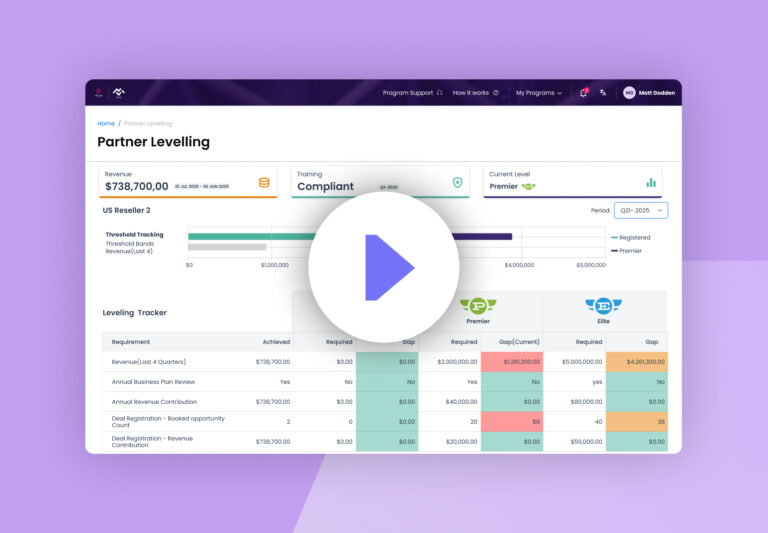
- A dashboard
- Real-time visibility
- Requirements checklist
- Progress bars
- Alerts
- What-if calculators
Automation helps vendors overcome the top 3 challenges of implementing a partner leveling program, as well as:
- Maintain accurate partner performance data
- Scale without adding people
- Improve consistency
- Model and test before launch
- Reduce chaos
Smart vendors use data transparency as a differentiator.

“The first thing partners always talk to us about is ease of doing business, creating a frictionless channel, or being easy as a vendor to work with, or very quickly, they’ll tell you the vendors that are not easy to work with. We often as vendors, we are a bit too inward-looking. We’re very focused on getting the program right, but not always thinking about that partner experience.”
Kenneth Fox
CTO & Founder
Channelscaler
“You’ve got to ensure the program isn’t asking partners to jump through multiple hoops… you’ve got to keep it simple.”

Kelly Woodfin
Commercial Director
Ricoh Europe
Change Without Chaos: Best Practices for Program Updates
It is clear that evolving a program in the changing partner ecosystem is necessary, but partners hate sudden change, so consider carefully reviewing your leveling program.
Best practice guidelines:
- Listen to your partners, actively seek feedback
- Refresh annually, not quarterly
- Evolutionary (not revolutionary) changes
- Communicate early and repeatedly
- Make changes incremental, not dramatically
- Test everything before rollout
Modeling & “What-If” Testing: Your Program’s Insurance Policy
Modern partner leveling programs are too complex, and too costly to launch without rigorous modeling. With expanded partner types, new lifecycle metrics, and more variables than ever, you need data-driven scenarios before you publish anything.
As Kenneth warns, “You cannot go back out during the year and change the tiering rules.”
Modeling and testing are the only ways to avoid mistakes you can’t fix later.
A strong modeling process helps you:
- Predict how many partners will land in each tier
- Prevent benefit and budget overruns
- Test requirement changes before they go live
- Avoid overcrowded top tiers
- Validate global consistency
- Ensure fairness across partner types
- Spot structural issues early
- Adjust safely before launch
Two Types of Modeling
1. Vendor Modeling
Vendor modeling ensures the program is operationally and financially viable:
Can you support the number of partners qualifying?
Do benefits, rebates, and incentives scale?
Do requirement changes skew distribution?
2. Partner Modeling
Partner modeling shows partners exactly how their actions change outcomes, for example:
- One more certification or deal
- Higher adoption or activation
- Better renewals or service delivery
Your Insurance Policy
Modeling and “what-if” testing safeguard your budget, partner trust, program stability, and internal credibility. If your thresholds, rules, and tier distribution haven’t been modelled, the program isn’t ready to launch.
“Testing and what-ifs are the fun part of designing partner programs!
You have to ask questions like: Are all of your partners going to reach the top tier? Do you have the in-house resources in services, sales, and training to support the partners who make it to those levels?
You design the program, and then there’s the moment of ‘oh no, we made the requirements too easy and now 50% of partners will hit the top level.’
So we test. A lot.
One side of what-if scenarios is understanding how many partners will land in each level.
The other is partner-facing, using automation tools to show partners that if they do a little more, they might reach a higher tier and unlock more value. What if they take one more training class? What if they get one more person certified? Can you show them that if they do more, they can reach a new level and unlock new benefits?”

Diane Krakora
CEO
PartnerPath
Reward Behaviors (Not Just Results)
Program benefits aren’t rewards, they’re motivators.
While performance matters, it’s the underlying behaviors that drive long-term growth, capability, and customer impact.
Modern programs are shifting toward behavior-based leveling because it motivates early-stage engagement, encourages learning and investment, drives activity even when sales cycles slow, and gives newer partners a fairer path to compete based on effort, not just revenue.
Many of the highest-performing programs now use more flexible points systems, behavior-based scoring, and weighted metrics that recognize high-value actions such as net-new logo acquisition, customer adoption work, or service delivery quality. By rewarding the behaviors that lead to results, vendors create a more balanced and motivational system that builds stronger, more committed partners over time.
28%
of poll respondents are currently using points to calculate their tiers, and we are seeing this number grow year-on-year.
The Future of Partner Leveling
01.
AI-driven partner scoring
Predictive indicators of partner success.
03.
Behavioral economics in program design
Small nudges -> big performance differences.
05.
More flexible tiers
Pick-your-benefits models instead of rigid bundles.
02.
Marketplace-led partner ecosystems
Where influence, not resale, becomes the main currency.
04.
Automated “next best action” insights
Portals that tell partners exactly what to do next.
Key Takeaways
Building a modern partner leveling program isn’t about checking boxes and rewarding revenue. It’s about:
- Motivating partners
- Driving behavior
- Simplifying engagement
- Investing in relationships
- Supporting growth
- Creating clarity
- Using data
- Rewarding impact
The more simple, transparent, and partner-centric your program is, the more likely partners are to engage deeply, and drive revenue you wouldn’t get otherwise.
The playbook is clear:
- Start with the customer needs
- Define partner types and what each values
- Build simple, behavior-driven requirements
- Model everything
- Automate wherever possible
- Communicate often
- Evolve gradually
Do this, and your leveling program won’t just classify partners, it will change their behavior, deepen their loyalty, and accelerate your ecosystem’s growth.